
SEO, GEO, and AI Search Direction.
Shape your search visibility around how people research, compare, and ask questions across Google, AI search, and generative engines.
Book a strategy call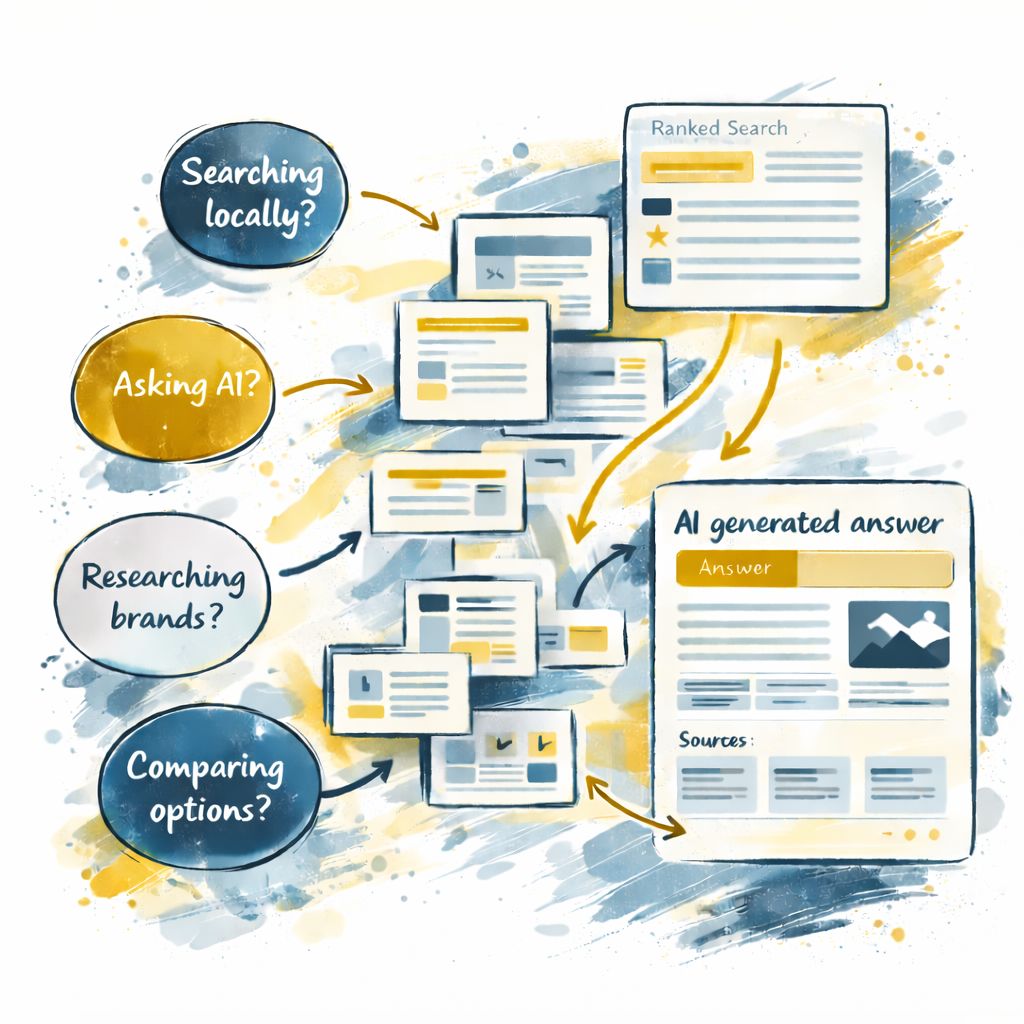
Search visibility no longer starts and ends with rankings.
Traditional SEO is still crucial, but it is no longer the full picture. People now discover brands through search results, AI overviews, answer engines, and conversational tools that summarise information before users ever click through to a website.
That changes the job. It is not just about ranking for keywords anymore. It is now about making sure your brand is easy to find, easy to interpret, and strong enough to be surfaced, cited, and trusted across both traditional search and AI-driven discovery.
The scope of this work.
This work shapes the search foundations behind how your website is found, understood, and referenced across traditional and AI-driven search.
SEO direction.
We define how your site should target search intent, organise topics, and support discoverability across traditional search. That includes content priorities, page-level direction, internal structure, and the role each page plays in helping users find and evaluate your offer.
GEO direction.
Generative engine optimisation focuses on how your brand is understood and referenced by AI systems that generate answers rather than just lists of links. This is not geo-targeting. It is about making your expertise, entities, claims, and supporting content clear enough to be surfaced in generative search experiences.
AI search direction.
AI search direction sits across both worlds. It considers how users phrase questions, how AI tools retrieve and summarise information, and how your site can support those journeys with clearer answers, stronger structure, and more usable content.
A connected approach to search performance.
💡 Traditional SEO, generative visibility, and AI-assisted discovery influence the same journey from different angles. If they are handled separately, gaps appear between how your site ranks, how your brand is interpreted, and where your content gets surfaced. This work brings those layers together so search visibility is built with fewer blind spots.
The foundation stronger search direction is built on.
Strong search direction depends on a few core decisions being made clearly from the start.
1. Search intent and topic coverage.
We identify what your audience is looking for, how those needs translate into search behaviour, and which topics your site needs to cover clearly. This prevents content from being created in isolation and gives your search presence a stronger strategic shape.
2. Page roles and search pathways.
Not every page should try to do the same job. We define which pages should capture discovery, which should support comparison, and which should help move users towards action. This creates a cleaner structure for both users and search engines.
3. Entity clarity and brand understanding.
AI systems rely on clear signals to understand who you are, what you do, and how your expertise fits within a topic. We help sharpen those signals across your site, so your brand is easier to interpret in generative search environments.
4. Content structure and retrievability.
Search engines and AI systems need content that is easy to parse, connect, and reuse. We shape content direction around clear sections, strong headings, logical relationships, and information that can be interpreted accurately rather than guessed.
5. Proof, credibility, and source strength.
Visibility increasingly depends on whether your content is strong enough to be trusted. We help define where proof points, evidence, expert signals, and citable material need to exist so your authority is reflected more clearly.
The difference between weak direction and clear direction.
Weak search direction creates problems across the site. Clear direction brings focus, consistency, and a stronger connection between visibility and performance.
What weak search direction looks like.
When search direction is weak, the same issues tend to surface across structure, content, and visibility. Common problems include:
- ❌ Keyword targeting without a clear content structure.
- ❌ Important pages with no defined role in search.
- ❌ Strong expertise buried in weak page formats.
- ❌ Inconsistent messaging across the site.
- ❌ AI systems surfacing competitors instead.
- ❌ Low-quality or generic content with nothing worth citing.
- ❌ Teams producing content without a joined-up search direction.
At that point, the issue is not volume. It is clarity, structure, and relevance.
What clear search direction changes.
When search direction is clearly defined, your website becomes easier to build around real search behaviour rather than broad assumptions. That leads to:
- ✅ Content that targets genuine decision points.
- ✅ Stronger alignment between search intent and page purpose.
- ✅ Clearer signals for search engines and AI systems.
- ✅ Better use of authority, proof, and expertise.
- ✅ A website that supports both rankings and references.
- ✅ Less wasted effort on disconnected content production.
This is what moves search from a checklist to a strategic asset.
How generative engines decide what to surface.
Generative engines do not evaluate content in quite the same way as traditional search. They look for clearer signals around credibility, structure, entity understanding, and whether information is strong enough to reuse in generated answers. It leads to a different set of checks:
Who benefits most from this work?
This service is especially useful during website planning, restructures, repositioning work, and growth phases where visibility needs to be built on something more sustainable than isolated tactics. It is most valuable for businesses that:
☑️ Rely on search visibility for leads or commercial discovery.
☑️ Have strong expertise but weak search structure.
☑️ Want to improve how they appear across AI search tools.
☑️ Are publishing content without clear strategic direction.
☑️ Need SEO and GEO to work together rather than in silos.
☑️ Want a stronger foundation before scaling search-led content.
What your business gets from this process.
The goal is not to hand over a list of disconnected tasks. It is to give you a clearer direction for how your website and content should support visibility now. Depending on the project, this can include:
💡 Search intent mapping.
💡 Topic and content direction.
💡 Page-level search roles.
💡 Recommendations for clearer site structure.
💡 GEO-specific recommendations for generative visibility.
💡 Guidance on citable, source-worthy content.
💡 AI search question and answer opportunities.
💡 Recommendations for stronger authority and brand clarity.
💡 A clearer roadmap for SEO, GEO, and AI search priorities.
The focus is search direction, not search noise.
A lot of SEO work becomes reactive. Publish more → Target more keywords → Add more pages → Adjust headings → Repeat.
This approach doesn’t necessarily create progress. Our work focuses on the bigger decisions first: what your audience is searching for, what your site needs to communicate, how your expertise should be structured, and what needs to exist for both search engines and generative engines to trust what they find.
That is what gives search activity a stronger foundation.
Frequently asked questions about SEO, GEO, and AI-driven search.
Get clear answers to common questions around search visibility, including how your brand is discovered across search engines and AI-driven platforms.
Generative engine optimisation (GEO) focuses on helping your brand appear in AI-generated answers. Instead of ranking pages, it ensures your content is clear, structured, and credible enough to be cited by AI systems like ChatGPT, Perplexity, and Google AI Overviews.
SEO focuses on improving rankings in search engine results pages. GEO focuses on getting your content referenced within AI-generated answers. Both rely on strong content and structure, but GEO places more emphasis on clarity, credibility, and how information is interpreted.
AIO (AI optimisation) refers to improving how your website performs across AI-driven search systems. It combines elements of SEO and GEO, focusing on how AI tools discover, interpret, and present your content in generated responses and summaries.
GEO is important because more users now rely on AI-generated answers to research products and services. If your content is not structured or credible enough to be referenced, your brand may not appear in those answers, even if your pages rank in traditional search results.
Search for questions your audience would ask in tools like ChatGPT, Perplexity, and Google AI results. Check if your brand is mentioned, cited, or used as a source in the answers. Repeat this across multiple queries to understand where you appear and where you don’t.
SEO can still drive traffic, but it no longer covers the full search landscape. As more users rely on AI-generated answers, combining SEO with GEO ensures your brand remains visible across both traditional and AI-driven discovery.
AI systems prefer content that is:
- Clearly written and easy to interpret.
- Structured with strong headings and sections.
- Directly answers common questions.
- Supported by evidence, examples, or expertise.
Content that is specific, factual, and well-organised is more likely to be cited.
GEO should be considered when planning new content, restructuring a website, or refining search strategy. Starting early ensures your site is built to support both traditional rankings and AI-driven visibility from the outset.
Start with a clearer search direction.
Send an enquiry with a few details about your website, search goals, or current challenges, and we’ll outline the most useful next steps.