
Website Planning for New Website Builds and Restructures.
Most websites are built without a clear plan. We define the structure, messaging, and search direction so your site is aligned, focused, and built to perform.
Book a strategy call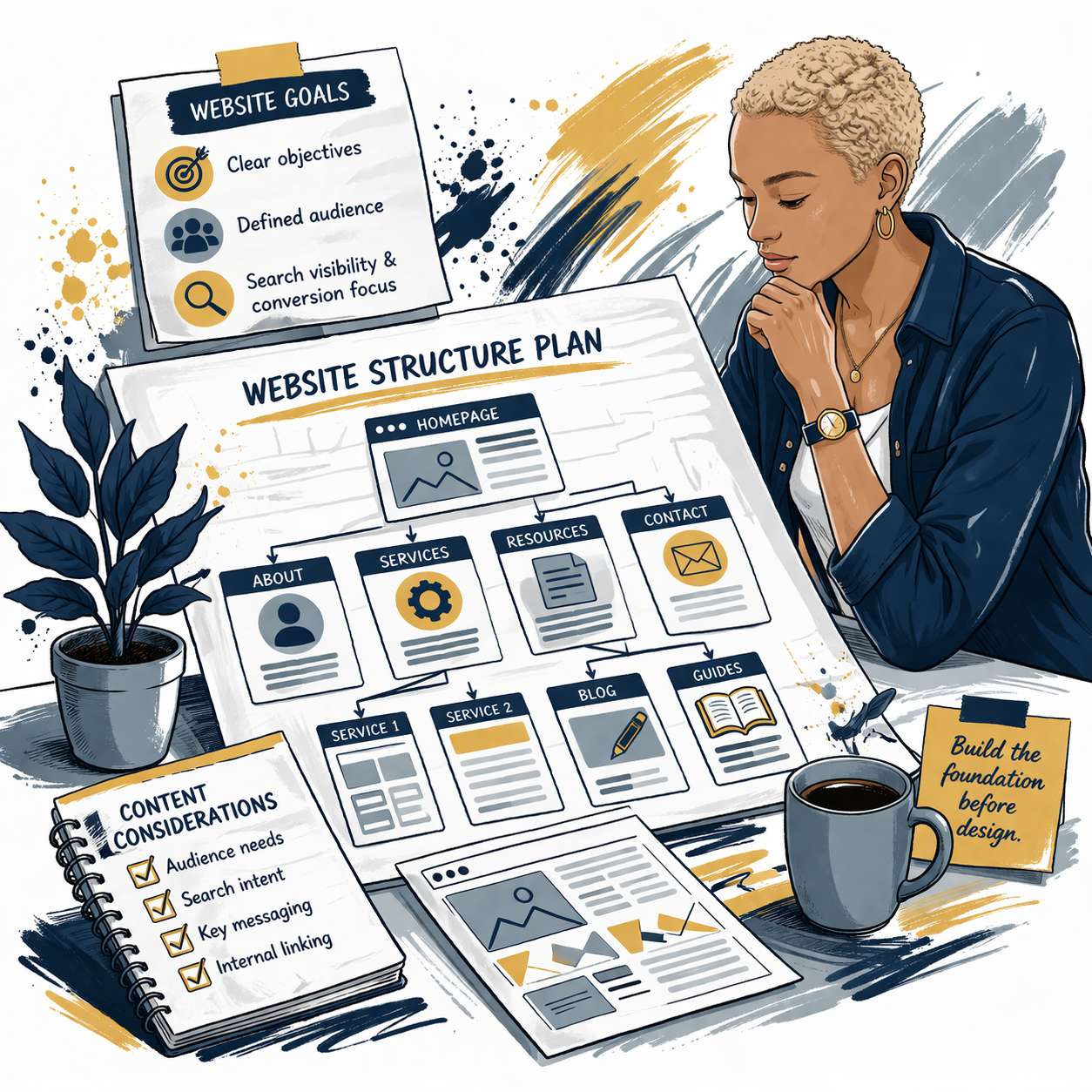
Plan your website before it gets built.
A website should reflect clear goals, a defined audience, and a structure that supports how people explore and make decisions. Without that, even well-designed sites struggle to perform.
We help you step back and plan the fundamentals first, including what the site needs to achieve, how it should be organised, and how content should support both search visibility and conversion. This creates a stronger foundation before design and development begin.
The foundations behind a well-structured website.
Website planning goes beyond listing pages or sketching a sitemap. It brings together business goals, user behaviour, content requirements, and search intent into one clear structure.
1. Defining goals and direction.
We start by understanding what the website needs to achieve and how success will be measured. That includes aligning business objectives with user actions, so every part of the site contributes to a clear outcome.
2. Understanding your audience.
We identify who the site is for, what they’re looking for, and how they move from discovery to decision. This ensures the structure and messaging reflect real behaviour, not assumptions.
3. Mapping pages and structure.
We define the pages your site needs and how they connect. This includes hierarchy, navigation, and user flow, so people can find what they need quickly and move through the site logically.
4. Aligning content and search.
We define content direction around how people search, compare, and evaluate solutions. This ensures your site is structured in a way that supports both visibility and usability from the start.
5. Bringing everything together.
We consolidate inputs from across your team—founders, marketers, designers, developers—into a single, aligned plan. This reduces friction, avoids conflicting decisions, and keeps the project moving in the right direction.
When to bring in structure and direction for your website project.
We work alongside your internal team or external partners, helping ensure the structure, messaging, and content direction stay aligned as the project moves forward. We’re typically brought in at key stages where clarity is needed most:
The impact of website planning.
Without a clear plan:
- ❌ Websites become harder to navigate.
- ❌ Messaging becomes inconsistent.
- ❌ SEO is treated as an afterthought.
- ❌ Teams make decisions in isolation.
- ❌ Projects take longer and cost more to fix later.
With the right planning in place:
- ✅ Structure supports how users behave.
- ✅ Content aligns with search and decision-making.
- ✅ Teams work from a shared plan.
- ✅ Projects move faster and more efficiently.
- ✅ The site performs better from launch.
Frequently asked questions about website planning.
Clear answers to common questions about website planning, website structure, redesign planning, and how to prepare a stronger foundation before design and development begin.
Website planning is the process of defining what a website needs to achieve before design and development begin. It covers goals, audience needs, page structure, messaging, search direction, content requirements, and user flow, so the site has a clearer foundation from the start.
Website planning helps prevent redesigns from becoming surface-level updates. It clarifies what the site needs to say, how pages should be structured, and how users should move through the site, so design and development decisions are based on strategy rather than guesswork.
A website plan should include goals, target audiences, page hierarchy, navigation, key messages, content requirements, SEO considerations, conversion paths, and responsibilities. The level of detail depends on the project, but the plan should give everyone involved a shared structure to work from.
Website planning defines the strategic structure behind the site. Website design turns that structure into the visual experience. Planning decides what pages are needed, how information should be organised, and what the site needs to support before layout, visuals, and development begin.
Website planning supports SEO by aligning site structure with search intent, page roles, and content opportunities. It helps ensure important topics have the right pages, pages are organised logically, and search engines can understand how the site’s content connects.
Website planning should happen before design and development begin. It is also useful before a redesign, restructure, or major content expansion, especially when the current site feels unclear, difficult to scale, or underperforming despite having useful content.
Yes, if the current site no longer reflects the business clearly. Website planning can help identify which pages to keep, improve, merge, remove, or create, so the existing site becomes easier to navigate, manage, and use as part of wider marketing activity.
Website planning usually involves business leaders, marketing teams, designers, developers, and anyone responsible for content or customer insight. The goal is to bring the right input together early, so the project does not move forward with conflicting assumptions.
Start with a clear plan.
Share a few details about your project and we’ll review your structure, identify gaps, and outline the next steps.