

Key takeaways.
- Digital strategy in marketing is about decisions, not activity. It defines how your digital presence guides people from discovery through to choosing your business.
- Most strategies fall short because nothing connects. Channels, content, and campaigns run in parallel, but don’t align with how people actually evaluate and decide.
- Positioning and structure shape everything that follows. If these aren’t clear, messaging drifts, navigation breaks down, and performance becomes harder to improve.
- Content and SEO only work when they support a clear path. Visibility is important, but growth depends on what happens after someone lands on your site.
- Clarity drives better outcomes than complexity. At VAMS, the focus is on aligning positioning, structure, and content into a system that supports consistent, long-term growth.

Digital strategy is used so loosely that it often gets lost in translation. It can refer to technology, operations, or marketing, depending on who’s speaking. That ambiguity creates confusion when the goal is growth. Here, the focus is on digital strategy in marketing, and how your digital presence supports how people find, evaluate, and choose you.
The term has lost its meaning.
Digital strategy gets used to label too many different things. A new website, an SEO plan, a CRM setup, a full transformation project. It all ends up under the same heading.
That creates confusion. Different teams hear it and think of completely different priorities. Marketing looks at channels and content. Product teams look at platforms. Leadership thinks in terms of transformation.
The result is a label that doesn’t point to a clear set of decisions. When the goal is growth, that lack of clarity makes it harder to prioritise what will move the business forward.
Most digital strategies don’t drive growth.
Even when a digital strategy exists, it often centres on tools, channels, and roadmaps. There’s a plan for SEO, a content calendar, paid campaigns running, and a website in place.
The issue is that these efforts rarely connect. Each part gets developed in isolation, with different goals, timelines, and expectations behind it. So activity builds, but it doesn’t compound. Traffic increases, content expands, campaigns run, but there’s no clear link between that activity and how people move towards a decision.
This gap is where most digital strategies fall short.
A clearer definition of digital strategy in marketing.
A more useful way to think about digital strategy in marketing is how your digital presence turns attention into decisions. It’s less about the channels you use and more about how everything connects once someone finds you. This includes what they see, how they navigate, what they understand, and what helps them move forward.
It’s where the focus shifts. Positioning, structure, content, discoverability, and decision alignment all play a role. Not as separate workstreams, but as parts of the same system. The goal is to make your digital presence work together in a way that supports growth.
Positioning and structure set the foundation.
Most issues with digital performance trace back to two things: unclear positioning and weak structure.
When positioning lacks clarity, messaging starts to drift. Pages say similar things in slightly different ways, and it becomes harder for someone to understand what you offer or why it’s important. This lack of focus carries across the entire experience.
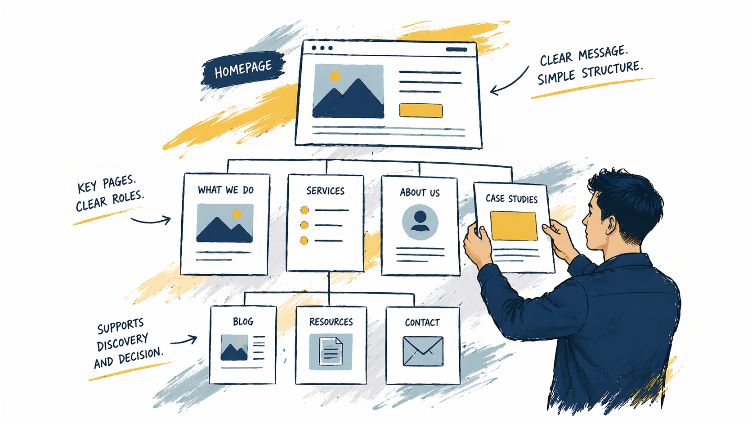
Structure adds another layer. Many websites grow over time without a clear plan behind them. Pages get added, navigation expands, and the logic behind it becomes harder to follow. From the outside, it feels disjointed.
Together, positioning and structure shape how your digital presence is understood. They influence how easily someone can navigate, how quickly they grasp what you do, and whether the experience feels clear or confusing.
When this layer isn’t right, everything built on top of it becomes harder to make effective.
Content only works when it has a role.
Content often grows without much direction behind it. Ideas get explored, blogs get published, and pages get added. Individually, it can all look useful, but taken together, it rarely forms a clear system.
The difference comes down to purpose. Some content needs to drive decisions. These are the core pages that explain what you offer, how it works, and why someone should choose you. Others exist to support discovery, helping people find you through search and understand the space you operate in.
When those roles aren’t defined, content overlaps, repeats itself, or competes for attention. It becomes harder for someone to move through the site with any sense of direction. Clarity here doesn’t require more content. It comes from knowing what each piece is there to do.
Discoverability and decision alignment drive growth.
SEO often gets treated as a separate layer. Keywords, rankings, and traffic targets sit on one side, while the rest of the site develops independently. This split creates problems. Content might attract visitors, but it doesn’t always match what they need next. Someone lands on a page, reads it, and then has to work out where to go or what to do.
Discoverability works best when it connects directly to decision-making. The way people search should lead into content that helps them evaluate, compare, and move forward with confidence.
Many brands focus heavily on visibility at the top of the funnel. They create content to attract attention, but don’t give the same attention to what happens after that first click. Growth comes from connecting both sides. Being found is crucial, but what happens next is what turns that attention into something valuable.
Clean strategy beats complex strategy.
A lot of digital strategies become more complicated than they need to be. More channels get added, more tools get introduced, and more activity gets layered on top. It can give the impression of progress, but it often makes things harder to manage and harder to understand.
Growth comes from clarity. Clear positioning, a logical structure, defined content roles, and a direct path from discovery to decision. When those pieces align, the system starts to work as one. Simplicity makes it easier to see how everything aligns, what’s working, what isn’t, and where to focus next.
Final thoughts.
Digital strategy isn’t separate from marketing anymore. It’s part of how your business gets found, understood, and chosen.
If your digital presence isn’t helping people do those things, it’s not doing its job. It doesn’t matter how many channels you’re on or how much content you produce. What’s critical is whether everything works together to support clear decisions. That’s where strategy earns its place.
If your current setup feels unclear or disconnected, it’s worth stepping back and looking at how everything fits together. You can book a strategy call to get a clearer view of where things stand and what to focus on next.

Frequently asked questions about digital strategy in marketing
If digital strategy has felt vague or difficult to pin down, you’re not alone. These are some of the questions that come up most often when trying to make sense of it.
What is digital strategy in marketing?
Digital strategy in marketing is how your digital presence supports how people find, evaluate, and choose your business. It connects positioning, website structure, and content into a system that guides users from discovery through to decision, rather than treating channels and tactics as separate activities.
Is digital strategy the same as digital marketing?
They’re closely related, but not the same. Digital marketing focuses on execution, such as campaigns, content, SEO, and paid channels. Digital strategy sits behind that work. It defines how everything fits together, what each part is meant to do, and how it contributes to growth.
What are the key components of a digital strategy?
A strong digital strategy in marketing usually includes positioning, website structure, content direction, discoverability, and decision alignment. These elements work together to create a clear path from first interaction through to conversion.
Why do many digital strategies fail to drive results?
Most digital strategies fall short because they focus on activity rather than alignment. Channels, content, and campaigns are developed separately, without a clear connection to how people make decisions. This leads to traffic and engagement, but limited impact on the end goal, which is growth.
How do you know if your digital strategy isn’t working?
Common signs include traffic that doesn’t convert, unclear messaging across pages, and content that feels disconnected or repetitive. If users can’t quickly understand what you offer or what to do next, the strategy behind it likely needs attention.
When should a business invest in digital strategy?
The best time is before a website build, redesign, or major growth push. It’s also valuable when your current setup feels unclear, underperforming, or difficult to scale. Addressing strategy early helps avoid rework and keeps everything aligned as the business grows.